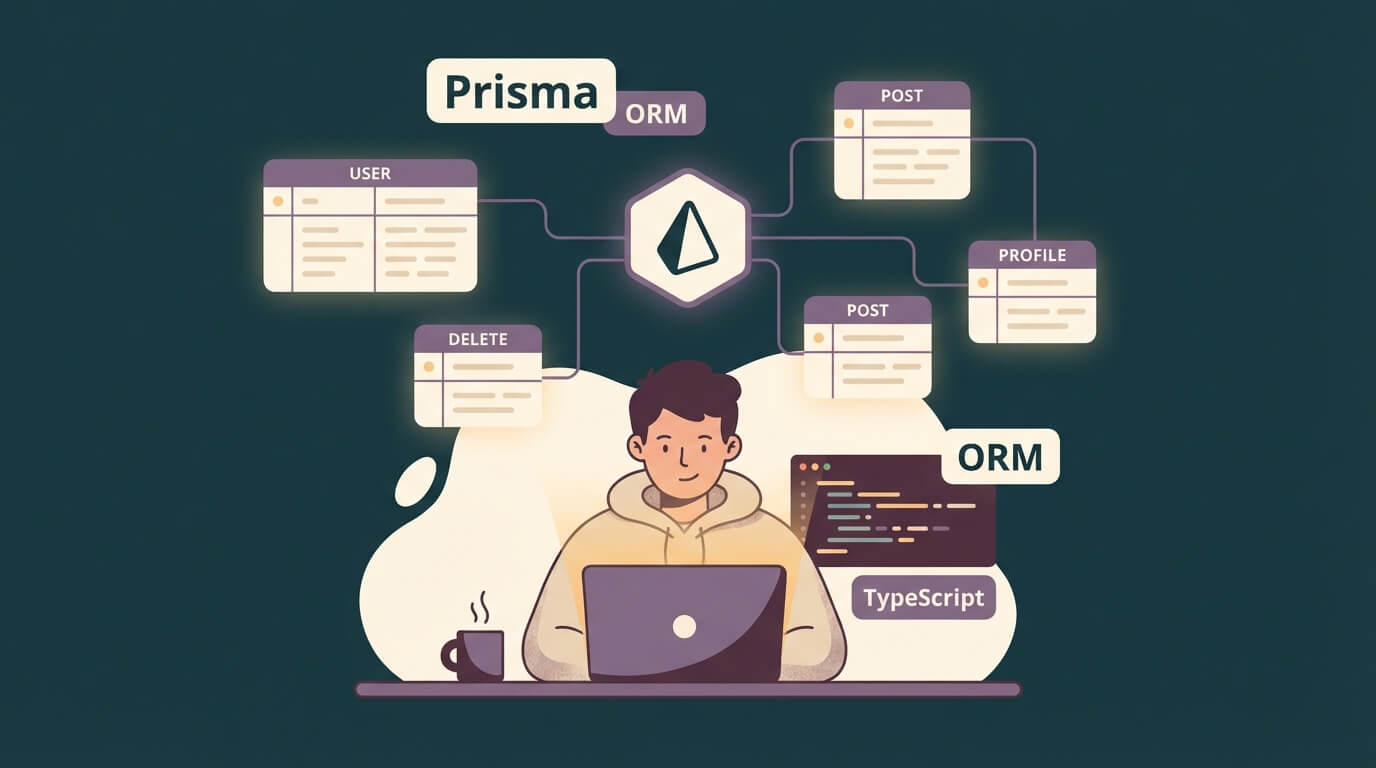
Prisma ORM Tutorial: Setup and Best Practices for TypeScript
Saturday, Dec 27, 2025
If you’ve ever used raw SQL queries or traditional ORMs like Sequelize, you probably know the pain of debugging queries that error at runtime. Typo in a column name? Error only discovered when the application runs.
Prisma takes a different approach: type-safe database access with auto-generated types from your schema. This means if there’s a typo or wrong query, TypeScript immediately warns you before the code runs.
What is an ORM?
ORM (Object-Relational Mapping) is an abstraction layer between your application and database. Instead of writing raw SQL:
SELECT * FROM users WHERE id = 1;You can use more readable syntax:
const user = await prisma.user.findUnique({ where: { id: 1 } });Why Prisma?
Prisma isn’t just any ORM. Here’s what makes Prisma stand out:
| Feature | Prisma | Traditional ORM |
|---|---|---|
| Type Safety | 100% type-safe | Partial or manual |
| Schema Definition | Prisma Schema Language | Decorators/JS Objects |
| Migrations | Automated & versioned | Manual or semi-auto |
| Query Building | Fluent API with autocomplete | String-based or builder |
| Tooling | Prisma Studio, CLI, VS Code extension | Varies |
Installation and Setup
1. Init Project
mkdir prisma-tutorial && cd prisma-tutorial
npm init -y
npm install typescript ts-node @types/node -D
npx tsc --init
2. Install Prisma
npm install prisma -D
npm install @prisma/client
3. Initialize Prisma
npx prisma initThis will create:
prisma/schema.prisma- Main schema file.env- Environment variables file
4. Configure Database
Edit .env with your database connection string:
# PostgreSQL
DATABASE_URL="postgresql://user:password@localhost:5432/mydb?schema=public"

# MySQL
DATABASE_URL="mysql://user:password@localhost:3306/mydb"

# SQLite (great for development)
DATABASE_URL="file:./dev.db"
Prisma Schema: The Heart of Prisma
The prisma/schema.prisma file is where you define your database structure:
// filepath: prisma/schema.prisma

generator client {
  provider = "prisma-client-js"
}

datasource db {
  provider = "postgresql"
  url      = env("DATABASE_URL")
}

model User {
  id        Int      @id @default(autoincrement())
  email     String   @unique
  name      String?
  password  String
  role      Role     @default(USER)
  createdAt DateTime @default(now())
  updatedAt DateTime @updatedAt

  posts    Post[]
  profile  Profile?
  comments Comment[]
}

enum Role {
  USER
  ADMIN
  MODERATOR
}
Attribute Explanation
| Attribute | Function |
|---|---|
@id | Primary key |
@unique | Value must be unique |
@default() | Default value |
autoincrement() | Auto increment for integer |
now() | Timestamp when record is created |
@updatedAt | Auto update timestamp when record is updated |
? | Optional field (nullable) |
Relations: 1:1, 1:N, and N:M
One-to-One (1:1)
User has one Profile:
model User {
  id      Int      @id @default(autoincrement())
  email   String   @unique
  profile Profile?
}

model Profile {
  id     Int    @id @default(autoincrement())
  bio    String?
  avatar String?

  userId Int  @unique
  user   User @relation(fields: [userId], references: [id])
}
One-to-Many (1:N)
User has many Posts:
model User {
  id    Int    @id @default(autoincrement())
  email String @unique
  posts Post[]
}

model Post {
  id        Int      @id @default(autoincrement())
  title     String
  content   String?
  published Boolean  @default(false)

  authorId Int
  author   User @relation(fields: [authorId], references: [id])
}
Many-to-Many (N:M)
Post has many Categories, Category belongs to many Posts:
model Post {
  id         Int        @id @default(autoincrement())
  title      String
  categories Category[]
}

model Category {
  id    Int    @id @default(autoincrement())
  name  String @unique
  posts Post[]
}
Prisma automatically creates a junction table. If you need an explicit junction table with additional fields:
model Post {
  id         Int            @id @default(autoincrement())
  title      String
  categories PostCategory[]
}

model Category {
  id    Int            @id @default(autoincrement())
  name  String         @unique
  posts PostCategory[]
}

model PostCategory {
  postId     Int
  categoryId Int
  assignedAt DateTime @default(now())

  post     Post     @relation(fields: [postId], references: [id])
  category Category @relation(fields: [categoryId], references: [id])

  @@id([postId, categoryId])
}
Migrations
After the schema is ready, run migration:
# Development: Create and apply migration
npx prisma migrate dev --name init

# Production: Apply pending migrations
npx prisma migrate deploy

# Reset database (deletes all data!)
npx prisma migrate reset
Migration Tips
- Always review generated SQL - Prisma generates SQL in the
prisma/migrations/folder - Don’t edit migration files - If you need to change, create a new migration
- Use descriptive names -
add_user_avataris better thanupdate_1
Generate Prisma Client
Every time the schema changes, regenerate the client:
npx prisma generateThis will generate types based on your schema.
CRUD Operations
Setup Prisma Client
// filepath: src/lib/prisma.ts
import { PrismaClient } from '@prisma/client';

const globalForPrisma = globalThis as unknown as {
  prisma: PrismaClient | undefined;
};

export const prisma = globalForPrisma.prisma ?? new PrismaClient();

if (process.env.NODE_ENV !== 'production') {
  globalForPrisma.prisma = prisma;
}
This pattern prevents multiple PrismaClient instances during hot reload in development.
Create
// Create single record
const user = await prisma.user.create({
  data: {
    email: '[email protected]',
    name: 'John Doe',
    password: 'hashedpassword',
  },
});

// Create with nested relation
const userWithProfile = await prisma.user.create({
  data: {
    email: '[email protected]',
    name: 'Jane Doe',
    password: 'hashedpassword',
    profile: {
      create: {
        bio: 'Full-stack developer',
        github: 'janedoe',
      },
    },
  },
  include: {
    profile: true,
  },
});

// Create many
const users = await prisma.user.createMany({
  data: [
    { email: '[email protected]', name: 'User 1', password: 'hash1' },
    { email: '[email protected]', name: 'User 2', password: 'hash2' },
  ],
  skipDuplicates: true, // Skip if email already exists
});
Read
// Find by ID
const user = await prisma.user.findUnique({
  where: { id: 1 },
});

// Find by unique field
const userByEmail = await prisma.user.findUnique({
  where: { email: '[email protected]' },
});

// Find first match
const admin = await prisma.user.findFirst({
  where: { role: 'ADMIN' },
});

// Find many
const allUsers = await prisma.user.findMany();

// Find with conditions
const activeAuthors = await prisma.user.findMany({
  where: {
    role: 'USER',
    posts: {
      some: {
        published: true,
      },
    },
  },
});
Update
// Update single
const updatedUser = await prisma.user.update({
  where: { id: 1 },
  data: { name: 'John Updated' },
});

// Update many
const deactivated = await prisma.user.updateMany({
  where: {
    lastLogin: {
      lt: new Date('2024-01-01'),
    },
  },
  data: {
    role: 'INACTIVE',
  },
});

// Upsert (update or create)
const user = await prisma.user.upsert({
  where: { email: '[email protected]' },
  update: { name: 'John Doe Updated' },
  create: {
    email: '[email protected]',
    name: 'John Doe',
    password: 'hashedpassword',
  },
});
Delete
// Delete single
const deleted = await prisma.user.delete({
  where: { id: 1 },
});

// Delete many
const deletedCount = await prisma.user.deleteMany({
  where: {
    role: 'INACTIVE',
  },
});
Advanced Queries
Filtering
// Multiple conditions
const users = await prisma.user.findMany({
  where: {
    AND: [
      { email: { contains: '@gmail.com' } },
      { role: 'USER' },
    ],
  },
});

// OR conditions
const users = await prisma.user.findMany({
  where: {
    OR: [
      { role: 'ADMIN' },
      { role: 'MODERATOR' },
    ],
  },
});

// NOT condition
const regularUsers = await prisma.user.findMany({
  where: {
    NOT: { role: 'ADMIN' },
  },
});
Sorting and Pagination
const posts = await prisma.post.findMany({
  orderBy: [
    { publishedAt: 'desc' },
    { title: 'asc' },
  ],
  skip: 10, // Offset
  take: 5,  // Limit
});
Select and Include
// Select specific fields
const users = await prisma.user.findMany({
  select: {
    id: true,
    email: true,
    name: true,
  },
});

// Include relations
const postsWithAuthor = await prisma.post.findMany({
  include: {
    author: {
      select: {
        id: true,
        name: true,
      },
    },
    categories: true,
  },
});
Prisma Studio
Prisma Studio is a GUI for exploring and editing data:
npx prisma studioIt will open browser at http://localhost:5555. You can:
- Browse all tables
- View and edit records
- Filter and sort data
- View relations
Performance Tips
1. Use Select to Limit Fields
// ❌ Fetches all fields including password
const users = await prisma.user.findMany();

// ✅ Only fetch what's needed
const users = await prisma.user.findMany({
  select: {
    id: true,
    email: true,
    name: true,
  },
});
2. Limit Nested Includes
// ❌ Deep nesting = many JOINs = slow
const post = await prisma.post.findUnique({
  where: { id: 1 },
  include: {
    author: {
      include: {
        posts: {
          include: {
            comments: {
              include: {
                author: true,
              },
            },
          },
        },
      },
    },
  },
});

// ✅ Split into multiple queries if needed
const post = await prisma.post.findUnique({
  where: { id: 1 },
  include: { author: true },
});

const comments = await prisma.comment.findMany({
  where: { postId: 1 },
  include: { author: { select: { id: true, name: true } } },
  take: 20,
});
3. Use Indexes in Schema
model Post {
  id        Int    @id @default(autoincrement())
  slug      String @unique
  authorId  Int
  published Boolean @default(false)
  createdAt DateTime @default(now())

  @@index([authorId])
  @@index([published])
  @@index([createdAt])
  @@index([published, createdAt]) // Composite index
}
4. Batch Operations
// ❌ Multiple round trips
for (const id of userIds) {
  await prisma.user.update({
    where: { id },
    data: { lastSeen: new Date() },
  });
}

// ✅ Single query
await prisma.user.updateMany({
  where: { id: { in: userIds } },
  data: { lastSeen: new Date() },
});
Best Practices
1. Project Structure
src/
├── lib/
│   └── prisma.ts          # Singleton Prisma client
├── repositories/          # Data access layer
│   ├── user.repository.ts
│   └── post.repository.ts
├── services/              # Business logic
│   ├── user.service.ts
│   └── post.service.ts
└── ...

prisma/
├── schema.prisma
├── seed.ts
└── migrations/
2. Repository Pattern
// filepath: src/repositories/user.repository.ts
import prisma from '@/lib/prisma';
import { Prisma } from '@prisma/client';

export const userRepository = {
  async findById(id: number) {
    return prisma.user.findUnique({
      where: { id },
      select: {
        id: true,
        email: true,
        name: true,
        role: true,
        profile: true,
      },
    });
  },

  async findByEmail(email: string) {
    return prisma.user.findUnique({
      where: { email },
    });
  },

  async create(data: Prisma.UserCreateInput) {
    return prisma.user.create({ data });
  },

  async update(id: number, data: Prisma.UserUpdateInput) {
    return prisma.user.update({
      where: { id },
      data,
    });
  },

  async delete(id: number) {
    return prisma.user.delete({
      where: { id },
    });
  },
};
3. Error Handling
import { Prisma } from '@prisma/client';

async function createUser(data: Prisma.UserCreateInput) {
  try {
    return await prisma.user.create({ data });
  } catch (error) {
    if (error instanceof Prisma.PrismaClientKnownRequestError) {
      // P2002: Unique constraint violation
      if (error.code === 'P2002') {
        throw new Error('Email already exists');
      }
      // P2025: Record not found
      if (error.code === 'P2025') {
        throw new Error('User not found');
      }
    }
    throw error;
  }
}
Conclusion
Prisma is a game-changer for database access in TypeScript:
- Type safety - Errors detected at compile time
- Developer experience - Autocomplete, Prisma Studio, excellent docs
- Migrations - Versioned, automated, predictable
- Performance - Query optimization, connection pooling support
- Ecosystem - Prisma Accelerate, Pulse, and growing community
Start with a simple schema, understand relations and queries, then scale up with the best practices discussed.